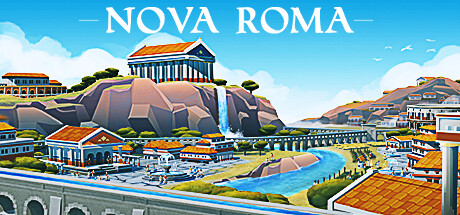
Nine days into Early Access and Nova Roma is sitting at 97% positive across 834 reviews on Steam. For a city builder from a three-person studio, those are remarkable numbers — the kind that suggest something genuinely clicked, not just with genre diehards but with a broader audience willing to take a bet on an unfinished game.
Who’s behind it
Lion Shield is the studio, and if the name doesn’t ring a bell, their previous game probably does: Kingdoms and Castles, the medieval city builder that launched in 2017 and quietly became one of Steam’s most beloved indie strategy titles. It’s the same core team — Pete Angstadt as Creative Director, with a tiny crew that somehow punches well above its weight.
The publisher is Hooded Horse, who have become something of a kingmaker for indie strategy games in recent years. Their CEO Tim Bender called Kingdoms and Castles “a gold standard in city-building games” when the partnership was announced at PC Gaming Show 2023. Given the Early Access reception, that confidence looks well-placed.
The premise
Rome has fallen into corruption, decay, and chaos. You lead a band of freed prisoners, escaped slaves, and disgruntled citizens away from the collapsing empire to build something new. Start with a humble village. Grow it into a metropolis. And when the jealous old empire inevitably comes knocking, defend what you’ve built.
It’s a clean setup that gives the game both a sandbox freedom and a narrative arc — you’re not just optimising supply chains in a vacuum, you’re building towards something while fending off existential threats.
What makes it different: water and gods
City builders are a crowded genre. Between Anno 117, Farthest Frontier, Timberborn, and a dozen others, any new entry needs a reason to exist. Nova Roma found two.
The water system
This is the headline feature and it deserves to be. Nova Roma has a gravity-based water simulation where rivers dynamically flow through the landscape, rainfall varies by season, and flooding is a genuine, devastating threat. You build dams, aqueducts, and reservoirs to control the flow — diverting water to irrigate farmland, feed bath houses, or simply stop your city from being washed away during a heavy rainy season.
Multiple reviewers have compared it to From Dust and Timberborn, which is high praise for a system that could easily have been a gimmick. Instead, it’s deeply integrated into city planning. Where you build matters because water flows downhill, soil fertility depends on proximity to water, and one miscalculated dam can flood half your settlement. It adds a layer of environmental strategy that most city builders simply don’t have.
The gods
Five Roman deities are currently in the game (with more planned), and they are needy. Build temples, dedicate them to specific gods, and complete their Divine Tasks to earn Favour — which unlocks nodes in an 85+ building technology tree. Neglect them and they punish you: Jupiter sends lightning, Neptune floods your city, and so on.
It’s not just a flavour system. The gods effectively structure your progression. Mars wants watchtowers; completing his tasks pushes you toward military infrastructure you might have ignored. The tasks feed into each other, subtly guiding expansion without feeling like a tutorial. And the threat of divine punishment adds genuine tension — you’re always balancing “what my city needs” against “what the gods demand.”
The city building core
Beneath the water physics and divine drama, Nova Roma is a solid, classic city builder. Free-form building placement (not grid-locked), complex supply chains from raw materials to finished goods, a full day/night cycle where different buildings operate at different hours, seasonal transitions, and a population with escalating needs — from basic food and water to pottery, wine, bread, games, and entertainment.
The comparisons to Anno are inevitable and not unfair. Island-based maps, class-based citizen tiers, production chains — it’s hitting similar notes. But Nova Roma trades Anno’s trade-route complexity for its water and divine systems, and the result feels distinct rather than derivative.
There’s also combat, though it’s lighter than the economic side. The old Roman Empire sends raiding parties and eventually armies. You build outposts, train militia, and can even weaponise the water system — flooding approaches to drown invaders. It’s a nice wrinkle rather than a core pillar.
Early Access state
Lion Shield says they plan about a year in Early Access. The current build is described as content-complete for its scope — both standard and creative/sandbox modes are playable, all core mechanics are functional, and the tech tree is substantial. Future plans include more gods, more mechanics, politics systems, and continued polish.
Performance is a known issue, particularly on Steam Deck where maintaining 50 FPS is a struggle. On desktop, it runs well on reasonable hardware (GTX 1050+ minimum). The game is also available on PC Game Pass as a Game Preview, which lowers the barrier significantly.
At $29.99 (currently 20% off at $23.99 through April 9), it’s priced in line with the genre. For comparison, Kingdoms and Castles launched at $9.99, so this is a meaningful step up — but the scope justifies it.
The bottom line
Nova Roma isn’t trying to reinvent the city builder. What Lion Shield has done is take the cozy, accessible charm of Kingdoms and Castles and scale it up with genuinely innovative water mechanics, a clever divine progression system, and enough depth to keep genre veterans engaged.
A 97% positive rating at 834 reviews is the kind of Early Access signal that’s hard to fake. Players are clearly finding something here that works — not just in the “promising foundation” sense, but in the “I’ve already lost 40 hours and it’s been a week” sense.
If you’re into city builders at all, this one deserves attention.
Nova Roma is available now in Early Access on Steam and PC Game Pass.
Developer: Lion Shield | Publisher: Hooded Horse | Price: $29.99 ($23.99 until April 9) | Platform: PC (Windows, Mac, Linux)